
When remote work replaced the traditional office, the commute vanished overnight.
At first, skipping the drive felt like a major win. No traffic reports, no crowded subway cars, no wasted hours sitting in gridlock.
Yet as the novelty faded, something essential disappeared with it: the natural, built-in transition that allowed the day to take shape.
When the distance between your pillow and your desk is ten paces, work loses its edges. The morning doesn’t begin with intention; it simply bleeds into obligation. The evening doesn’t end with relief; it just dissolves into the domestic background.
It turns out we didn’t need a grueling 45-minute trek across town. What we needed was a transition—a boundary built not out of exhaustion, but out of movement.

The Cognitive Power of a Short Walk
Walking serves as an automatic mental reset.
Even a ten-minute walk gives your mind the physical runway it needs to reorient. It allows you to leave the personal domestic context behind and step deliberately into a working state.
-
Entering the day: Movement wakes up the nervous system, clears morning brain fog, and helps you prioritize what matters before opening your first tab.
-
Exiting the day: The walk home provides closure. It gives your thoughts a buffer to process the afternoon’s loose ends so you aren’t carrying unfinished work tasks straight to the dinner table.
A short walk isn’t long enough to become an exhausting chore, but it is just long enough to create a distinct boundary. Work gains clear edges without adding friction to your life.
Neighborhood-Scale vs. City-Scale Work
There is a significant difference between commuting across a metropolitan center and working within your local radius.
City-scale work forces you to plan your life around transit schedules, parking costs, and traffic flow. It turns the simple act of going to work into a major logistical production.
Neighborhood-scale work operates on a completely different rhythm:
-
You stay within a familiar, comfortable radius.
-
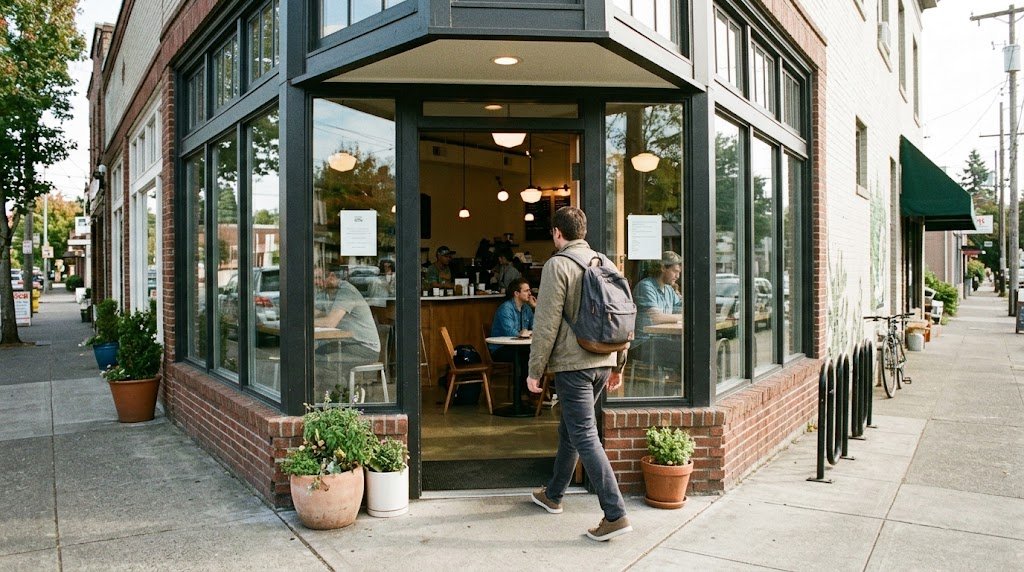
You walk past familiar corners, local businesses, and neighborhood spots.
-
Work becomes a natural component of your daily neighborhood routine rather than an intrusion that pulls you far away.
When your workspace sits just down the street or near a local transit stop, work remains present and productive, but contained. It is close enough to feel effortless, yet just far enough to protect your peace at home.

Intention on Arrival, Closure on Departure
When you work where you live, ending the workday requires sheer discipline. You have to actively resist the urge to glance at your screen while making dinner or answer “one quick message” right before bed.
When your workspace is outside the house, the boundary is physical.
You arrive with intention because you made a conscious choice to step into an environment built for focus. When you pack your bag and walk out the door, the day is finished. You don’t have to negotiate with yourself about whether you are still “on the clock”—the physical separation does the heavy lifting for you.
A healthy work routine doesn’t require choosing between an isolating home office and a soul-crushing corporate commute. There is a middle ground that keeps your life simple while giving your brain the breathing room it needs.
When your workspace is close to home—but firmly outside of it—your focus is easier to step into, and infinitely easier to leave behind at the end of the day.